Electric or Nitrogen? Cryo-Chamber Technologies Compared
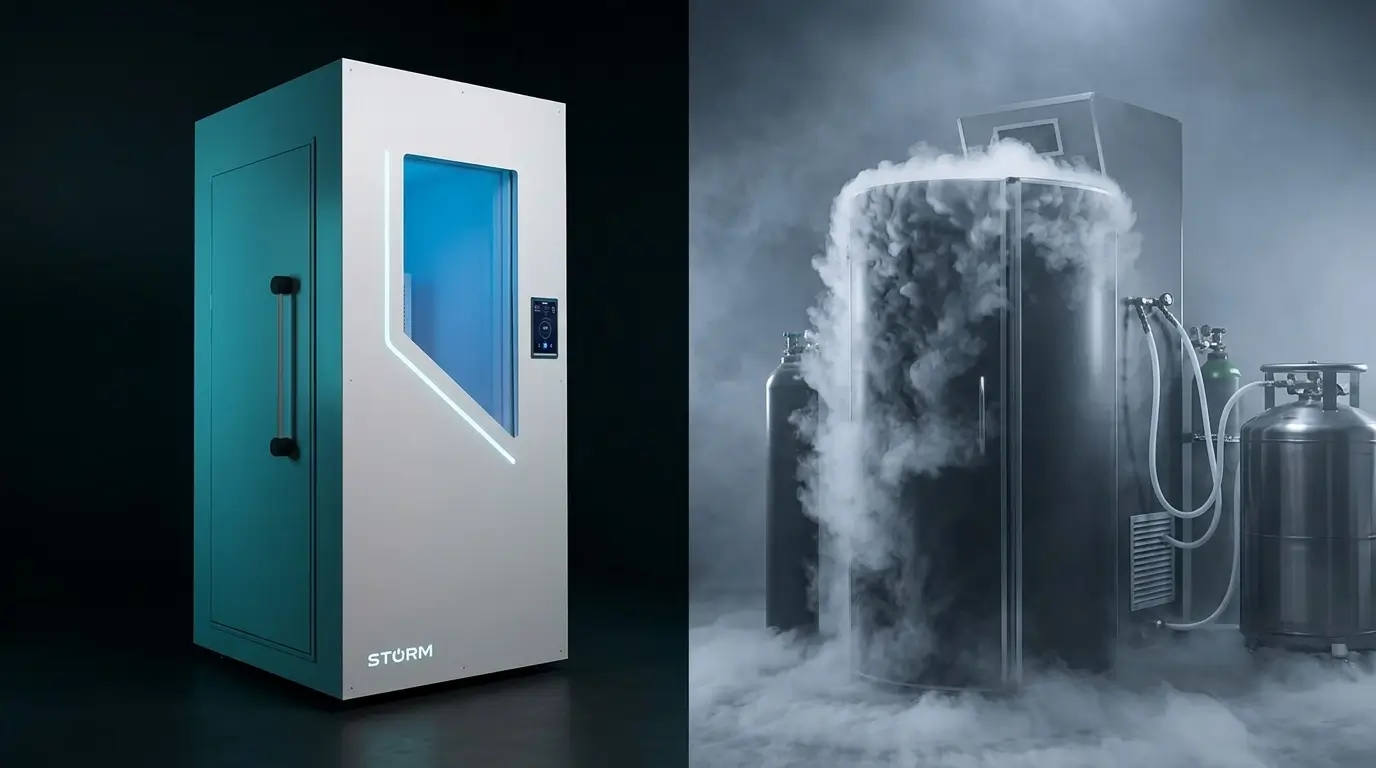
Anyone acquiring a cryo chamber eventually faces a fundamental choice: electric cold generation or nitrogen? Both produce deep cold – but they differ markedly in safety, temperature consistency, operation and economics. This article sets out the engineering without condemning either method wholesale.
Two ways to make cold
The scientific literature describes two basic principles (Bouzigon et al., Journal of Thermal Biology, 2016):
- Nitrogen-based: Liquid nitrogen vaporises and cools the air. In partial-body cabins (cryosaunas) the nitrogen is sprayed directly into the cabin; in nitrogen-cooled whole-body chambers it circulates within the walls, without entering the interior.
- Electric (mechanical refrigeration): A compression refrigeration circuit cools the air – the same physical principle as a heat pump, only in reverse. No consumable, no nitrogen storage.
A third important distinction: whole-body chambers are further divided into static-cooled and windchill-based (forced-convection) designs (Bouzigon et al., Frontiers in Sports and Active Living, 2021).
Safety: the decisive difference
The most safety-relevant difference concerns breathing air. In partial-body cryosaunas with direct nitrogen injection, the heavy nitrogen gas collects in the lower part of the cabin – which is why the head must remain outside, as free nitrogen gas poses an asphyxiation risk (Lombardi et al., Frontiers in Physiology, 2017; Bouzigon et al., 2016). Whole-body nitrogen chambers address this by circulating the nitrogen only within the walls; they nonetheless require continuous oxygen monitoring. In documented study protocols the chamber’s oxygen level is accordingly monitored constantly with separate sensors.
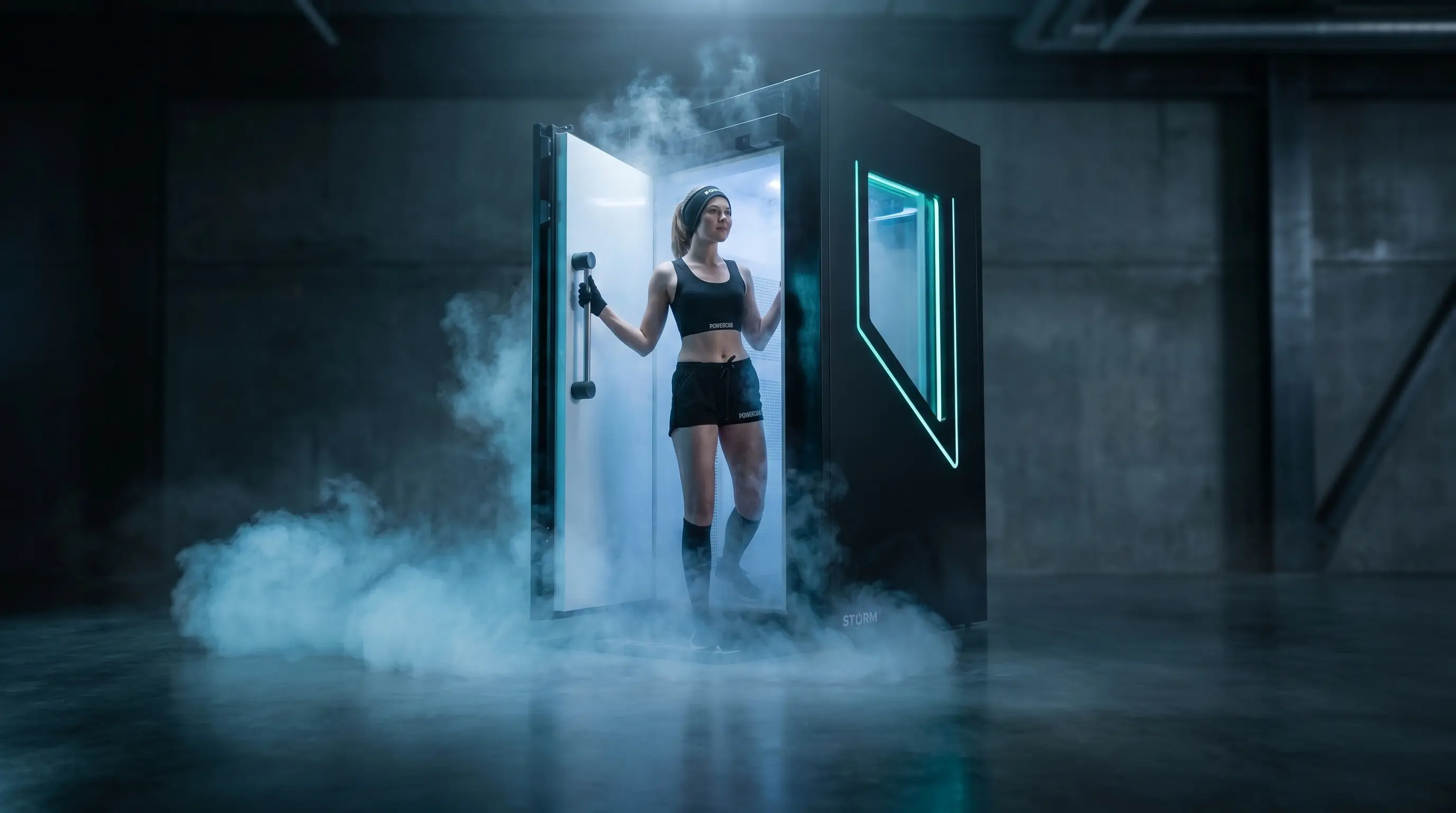
Electric whole-body chambers work with a consistently breathable cold-air environment. There is no free nitrogen gas in the interior – the entire body including the head can remain in the chamber, which is what makes a true whole-body application possible in the first place.
Temperature consistency: measured, not claimed
An often-underestimated point is how consistently the target temperature is actually held. In nitrogen-based systems, control is achieved by re-spraying once the interior temperature rises above a threshold. The amplitude between control points can reach 10 to 20 °C, which makes precise temperature control difficult (Bouzigon et al., 2016).
How large the spatial differences can become was shown by a measurement study on a cryosauna (Savic et al., Journal of Thermal Biology, 2013): in the empty cabin the temperature at the nozzle fell below –150 °C but stayed at around –60 °C in the middle. With a person inside, after three minutes the temperature was around –100 °C in the upper and –140 °C in the lower part of the cabin – a substantial vertical gradient. The temperatures actually measured at the body differed markedly from the one displayed on the device.
This heterogeneity is not unique to nitrogen – cold air is inherently denser and stratifies downward (Jdidi et al., Journal of Physiological Anthropology, 2024). What matters is therefore the quality of temperature control: a larger cold-air volume and even distribution make the application more reproducible.
Operation and economics
Nitrogen is an ongoing consumable. For individual models, annual nitrogen costs of roughly 20,000 to 30,000 euros have been reported (Bouzigon et al., 2016); storage and regulatory requirements add to this. Electric systems incur electricity costs instead, but need no consumable and no nitrogen logistics – a factor that weighs on site planning and on the calculation across the service life.
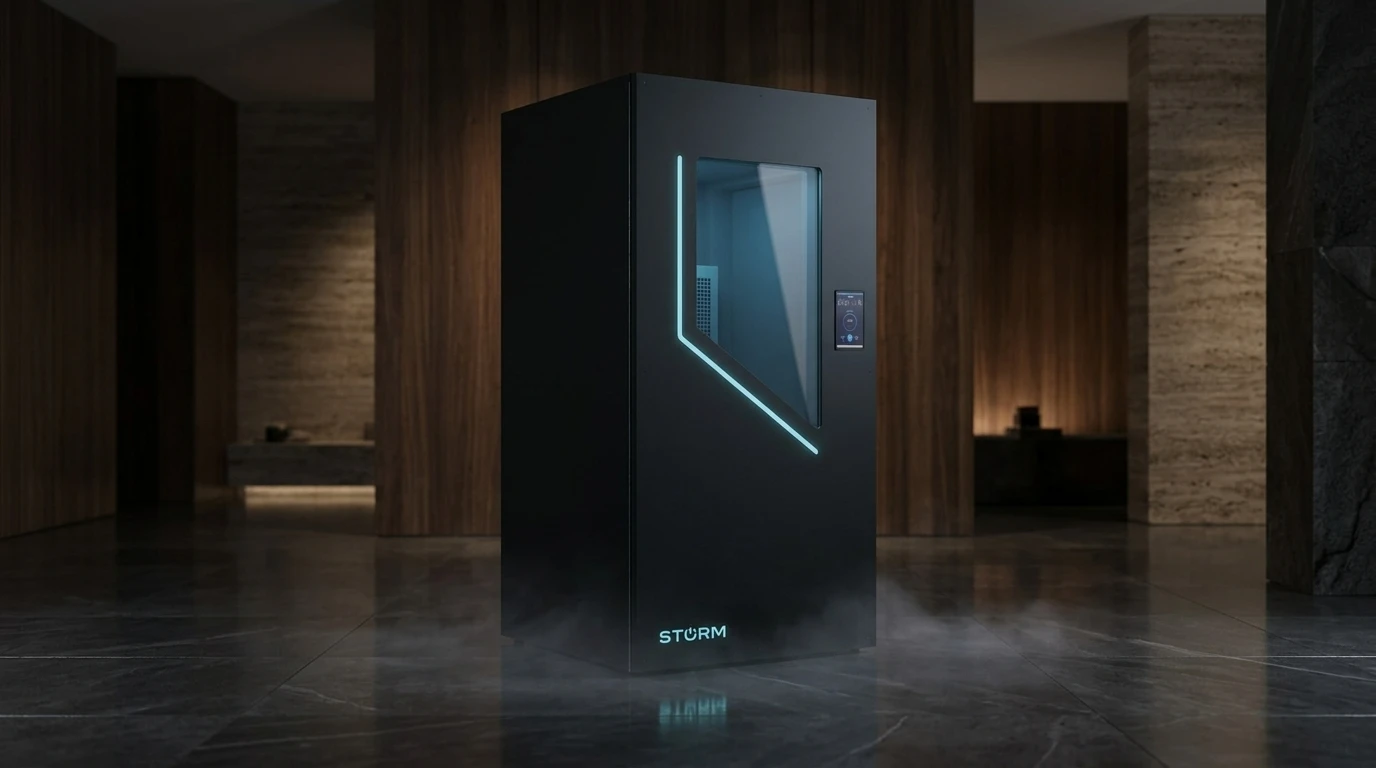
The POWERCAB uses electric cold generation with 100% natural refrigerant and reaches temperatures down to −110 °C – depending on the model as selectable windchill levels (−70/−90/−110 °C) or as an evaporator temperature of −110 °C. Power consumption ranges from 2 to 7 kW depending on the model.
What this means for the physiological effect
The temperature question is not merely one of comfort. What matters is not a briefly displayed peak value, but that the cold reaches the body reliably and reproducibly. A system that holds its target temperature evenly and reaches it repeatably makes every session comparable.
Conclusion
Nitrogen and electric cold both reach the goal, but by different routes. Electric whole-body chambers score with breathable interior air, no consumable and well-controllable temperature; nitrogen-based systems reach very low temperatures but require storage, safety precautions and careful temperature control. For continuous commercial operation, the electric design is in many cases the more practical choice – which is exactly where the POWERCAB positions itself.
👉 Learn more about the POWERCAB
Sources
- Bouzigon R, Grappe F, Ravier G, Dugué B (2016): Whole- and partial-body cryostimulation/cryotherapy: current technologies and practical applications. Journal of Thermal Biology 61:67–81. DOI
- Bouzigon R et al. (2021): Cryostimulation for post-exercise recovery in athletes: a consensus and position paper. Frontiers in Sports and Active Living 3:688828. Full text (PMC)
- Lombardi G, Ziemann E, Banfi G (2017): Whole-body cryotherapy in athletes: from therapy to stimulation. An updated review of the literature. Frontiers in Physiology 8:258. Full text (PMC)
- Savic M, Fonda B, Sarabon N (2013): Actual temperature during and thermal response after whole-body cryotherapy in cryo-cabin. Journal of Thermal Biology 38:186–191. DOI
- Jdidi H, de Bisschop C, Dugué B, Bouzigon R, Douzi W (2024): Optimal duration of whole-body cryostimulation exposure to achieve target skin temperature: influence of body mass index. Journal of Physiological Anthropology 43:28. DOI
- Louis J, Theurot D, Filliard J-R, Volondat M, Dugué B, Dupuy O (2020): The use of whole-body cryotherapy: time- and dose-response investigation on circulating blood catecholamines and heart rate variability. European Journal of Applied Physiology 120:1733–1743. Full text (PMC)
blogs/news